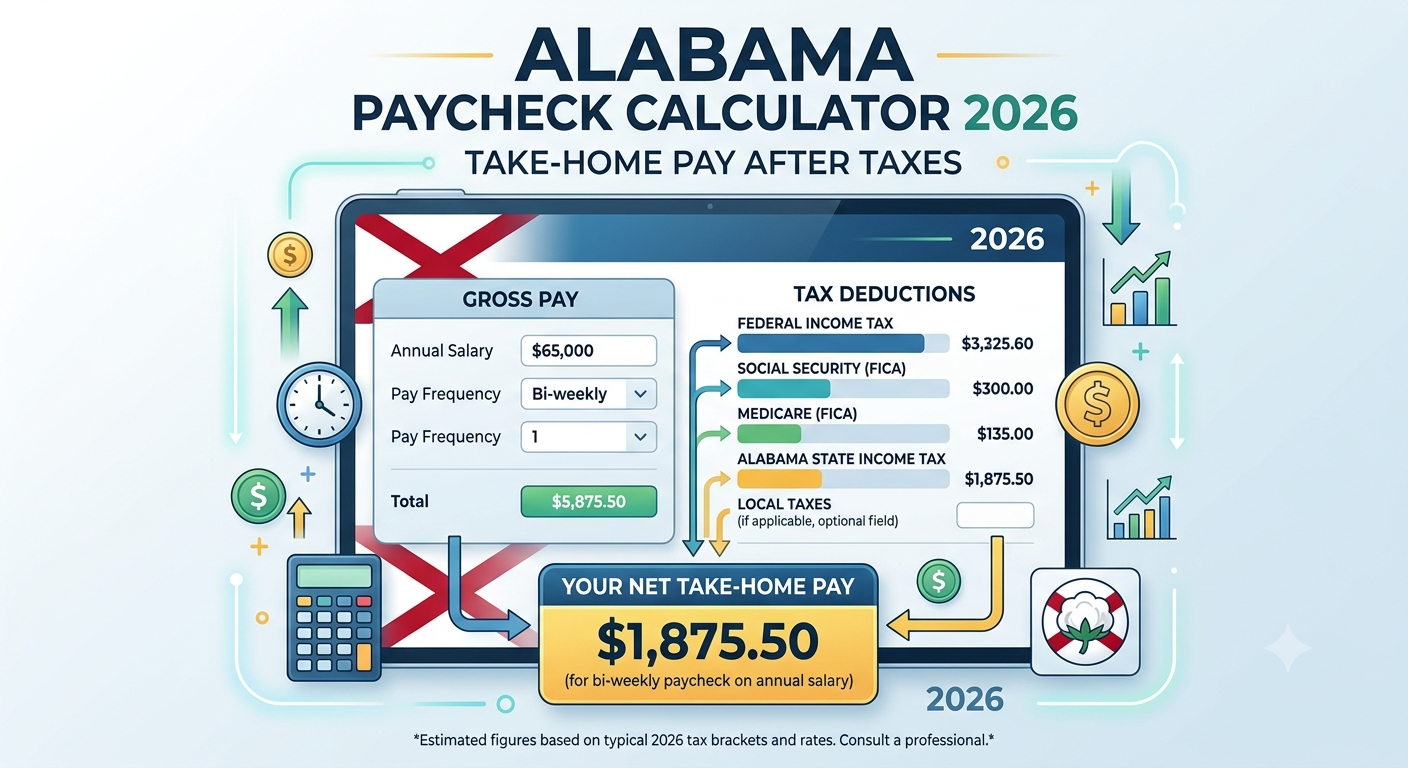
If you’re looking for an Alabama paycheck calculator 2026, this guide can help you estimate how much of your paycheck you’ll actually take home after taxes and common payroll deductions. Your gross salary isn’t the same as your net pay because federal income tax, Alabama income tax, Social Security, Medicare, benefits, and other deductions can reduce your paycheck.
The Alabama paycheck calculator is useful for employees comparing job offers, checking a pay stub, planning a household budget, or estimating weekly, biweekly, semimonthly, or monthly take-home pay.
For 2026, Alabama continues to use graduated individual income tax rates of 2%, 4%, and 5%. The highest Alabama rate applies to taxable income above the state’s lower brackets.
Federal payroll taxes also matter. For 2026, the employee Social Security tax rate is 6.2% up to the $184,500 Social Security wage base, while Medicare tax is 1.45% with no wage base limit. An additional 0.9% Medicare withholding applies to wages above $200,000 paid by an employer during the year.
Alabama Paycheck Calculator 2026: Quick Overview
| Payroll item | 2026 information |
|---|---|
| Alabama income tax | 2%, 4%, and 5% graduated rates |
| Federal income tax | 10%–37% marginal rates |
| Social Security | 6.2% employee rate |
| 2026 Social Security wage base | $184,500 |
| Medicare | 1.45% employee rate |
| Additional Medicare | 0.9% on wages over $200,000 |
| Federal standard deduction — Single | $16,100 |
| Federal standard deduction — Married Filing Jointly | $32,200 |
| Federal standard deduction — Head of Household | $24,150 |
The federal 2026 standard deduction is $16,100 for single filers and married individuals filing separately, $32,200 for married couples filing jointly, and $24,150 for heads of household.
Comprehensive Article Outline
| Section | What it covers |
| Alabama Paycheck Calculator 2026 | Overview of Alabama take-home pay |
| How the Calculator Works | Gross pay, taxes, and deductions |
| Alabama Income Tax | State tax brackets and withholding |
| Federal Income Tax | 2026 federal rates |
| FICA Taxes | Social Security and Medicare |
| Standard Deduction | 2026 federal deductions |
| Pay Frequency | Weekly through annual pay |
| Salary Examples | Common Alabama salaries |
| Hourly Pay | Converting hourly wages to salary |
| Overtime | How overtime can affect pay |
| Filing Status | Single, married, and head of household |
| Pre-Tax Deductions | Retirement and benefits |
| Post-Tax Deductions | Common after-tax deductions |
| Alabama Tax Considerations | State-specific information |
| Paycheck vs. Tax Return | Why withholding isn’t final tax |
| Ways to Estimate Net Pay | Practical calculation steps |
| Common Mistakes | Errors to avoid |
| FAQs | Frequently asked questions |
| Conclusion | Key takeaways |
What Is an Alabama Paycheck Calculator?
An Alabama paycheck calculator estimates your net or take-home pay from your gross wages. Gross pay is the amount you earn before deductions. Net pay is the amount that reaches your bank account after applicable taxes and deductions.
For example, if your annual salary is $60,000, you don’t normally receive $60,000 divided by 12 as your monthly take-home pay. Payroll withholding reduces each paycheck.
A paycheck estimate can include:
- Federal income tax
- Alabama income tax
- Social Security tax
- Medicare tax
- Retirement contributions
- Health insurance
- Dental insurance
- Vision insurance
- Flexible spending contributions
- Other payroll deductions
The exact result depends on your income, filing status, Form W-4 information, pay frequency, benefits, retirement contributions, and other circumstances.
That’s why two Alabama employees earning the same gross salary can have different take-home pay.
How Does the Alabama Paycheck Calculator Work?
The basic calculation starts with gross wages and subtracts applicable taxes and deductions.
A simplified formula is:
Gross Pay − Federal Tax − Alabama Tax − Social Security − Medicare − Other Deductions = Estimated Take-Home Pay
Suppose an employee earns $1,500 every two weeks. The calculator starts with that gross paycheck and estimates the applicable payroll taxes.
However, payroll withholding isn’t simply a fixed percentage of gross income. Federal income tax depends on taxable income, filing status, withholding information, and other factors.
The same principle applies to Alabama income tax. Alabama uses graduated tax rates, meaning different portions of taxable income can be taxed at different rates.
This is important because a 5% Alabama marginal rate doesn’t mean every dollar of your gross salary is automatically taxed at 5%.
Alabama Income Tax Rates for 2026
Alabama has a graduated individual income tax system.
For single taxpayers, heads of family, and married individuals filing separately, Alabama lists:
- 2% on the first $500 of taxable income
- 4% on the next $2,500
- 5% on taxable income above $3,000
For married couples filing jointly, Alabama lists:
- 2% on the first $1,000 of taxable income
- 4% on the next $5,000
- 5% on taxable income above $6,000
These are Alabama’s individual income tax rates reported by the Alabama Department of Revenue.
Alabama also provides different filing statuses and personal exemptions. The Alabama Department of Revenue lists a $1,500 personal exemption for single taxpayers and married taxpayers filing separately, and a $3,000 exemption for married couples filing jointly and heads of family.
Because Alabama taxable income isn’t necessarily the same as gross wages, you shouldn’t simply multiply your entire salary by 5% to estimate your state tax.
Federal Income Tax in Alabama
Living and working in Alabama doesn’t eliminate federal income tax. Most employees have federal income tax withheld from their paychecks.
For 2026, federal individual income tax rates range from 10% to 37%. The IRS published the 2026 tax brackets and inflation-adjusted amounts for the year.
For a single filer, the 2026 federal taxable-income brackets include:
| Federal rate | Taxable income range |
| 10% | $0–$12,400 |
| 12% | $12,401–$50,400 |
| 22% | $50,401–$105,700 |
| 24% | $105,701–$201,775 |
| 32% | $201,776–$256,225 |
| 35% | $256,226–$640,600 |
| 37% | Over $640,600 |
These are marginal tax brackets. Reaching a higher bracket doesn’t mean your entire income is taxed at that higher rate.
For married couples filing jointly, the 2026 brackets are different, so filing status can have a major effect on estimated federal withholding.
2026 Federal Standard Deduction
The federal standard deduction can significantly affect taxable income.
For tax year 2026, the standard deduction is:
| Filing status | 2026 standard deduction |
| Single | $16,100 |
| Married Filing Separately | $16,100 |
| Married Filing Jointly | $32,200 |
| Head of Household | $24,150 |
These amounts are published by the IRS for tax year 2026.
The standard deduction is one reason gross salary and federal taxable income aren’t identical.
For example, someone earning $50,000 in wages doesn’t necessarily have $50,000 of federal taxable income.
Social Security and Medicare Taxes
Federal payroll taxes also include FICA taxes.
For 2026, employees generally pay:
Social Security: 6.2%
Medicare: 1.45%
Together, those employee FICA rates equal 7.65% before considering any special circumstances.
The 2026 Social Security wage base is $184,500. Once an employee reaches that wage base for the year, additional wages aren’t subject to the 6.2% employee Social Security tax. Medicare has no wage base limit.
Employees with wages above $200,000 during the year can also have an additional 0.9% Medicare withholding applied to wages above that threshold.
Weekly, Biweekly, Semimonthly, and Monthly Pay
Your annual salary doesn’t change just because your employer pays you more frequently, but the size of each paycheck does.
Common pay frequencies include:
| Pay frequency | Typical pay periods |
| Weekly | 52 |
| Biweekly | 26 |
| Semimonthly | 24 |
| Monthly | 12 |
For example, a $52,000 annual salary is approximately:
- $1,000 weekly
- $2,000 biweekly
- $2,166.67 semimonthly
- $4,333.33 monthly
These are gross-pay estimates before taxes and deductions.
Your actual take-home amount will depend on withholding and benefits.
Alabama Salary Paycheck Examples
Here are simplified examples of gross pay by salary and pay frequency:
| Annual salary | Weekly gross | Biweekly gross | Monthly gross |
| $40,000 | $769.23 | $1,538.46 | $3,333.33 |
| $50,000 | $961.54 | $1,923.08 | $4,166.67 |
| $60,000 | $1,153.85 | $2,307.69 | $5,000 |
| $75,000 | $1,442.31 | $2,884.62 | $6,250 |
| $100,000 | $1,923.08 | $3,846.15 | $8,333.33 |
These figures show gross pay only. They aren’t promises of actual Alabama take-home pay because federal taxes, Alabama taxes, FICA, and individual deductions must be considered.
For an accurate estimate, enter your actual salary, pay frequency, filing status, and deductions into the calculator.
Alabama Hourly Paycheck Calculator
An Alabama paycheck calculator can also be useful for hourly employees.
To estimate annual gross wages:
Hourly Rate × Hours Per Week × Weeks Per Year = Annual Gross Pay
For a worker earning $20 per hour and working 40 hours each week:
$20 × 40 × 52 = $41,600
That gives an estimated annual gross wage of $41,600 before overtime, bonuses, unpaid time off, or other adjustments.
Hourly employees should also consider overtime.
Alabama Overtime Pay
Overtime can increase gross wages and therefore affect payroll withholding.
For an eligible employee paid $20 per hour, a basic time-and-a-half overtime rate would be:
$20 × 1.5 = $30 per overtime hour
If the employee works 5 overtime hours, those hours would add:
5 × $30 = $150
to gross wages for that pay period.
Overtime tax treatment can be more complicated than simply applying a flat tax percentage to the extra earnings. Your payroll withholding may change based on the size of the paycheck and your withholding information.
The federal tax rules also include special provisions for certain qualified overtime compensation for eligible taxpayers under current law, so employees with significant overtime should check current IRS guidance rather than relying on a simple rule of thumb.
Filing Status and Alabama Take-Home Pay
Your filing status can influence federal income tax withholding and Alabama tax calculations.
Common federal filing statuses include:
- Single
- Married Filing Jointly
- Married Filing Separately
- Head of Household
Alabama also recognizes its own filing categories, including single, married filing jointly, married filing separately, and head of family.
For this reason, two employees earning the same salary can have different estimated take-home pay.
For example, a single employee and a married employee with the same gross income may have different federal withholding because the applicable federal brackets and standard deductions differ.
Pre-Tax Payroll Deductions
Some employee benefits can reduce taxable wages depending on the type of benefit and applicable tax rules.
Common examples can include:
- Traditional 401(k) contributions
- Certain employer health plans
- Health savings account contributions
- Flexible spending accounts
However, not every deduction reduces every type of tax.
A retirement contribution may affect federal income tax while still being subject to certain payroll taxes, depending on the specific arrangement.
That’s why a reliable Alabama paycheck calculator 2026 should treat deductions carefully instead of subtracting every benefit from every tax category.
Post-Tax Payroll Deductions
Some deductions are taken after applicable taxes have been calculated.
Examples can include:
- Certain insurance premiums
- Union dues
- Garnishments
- Voluntary employee purchases
- Some retirement or benefit contributions
The exact treatment depends on the deduction.
If you’re checking why your paycheck is lower than expected, compare your gross earnings and each individual deduction on your pay stub.
Alabama Paycheck vs. Alabama Tax Return
A paycheck calculator estimates withholding, not your final tax liability.
Your employer withholds estimated taxes during the year. When you file your tax return, your actual tax liability is calculated using your income, deductions, credits, filing status, and other applicable information.
You may receive a refund if you paid more than your final liability, or you may owe additional tax if your withholding was insufficient.
Therefore, an Alabama paycheck calculator should be viewed as a planning tool rather than a substitute for a tax return.
For official Alabama tax information, use the Alabama Department of Revenue Individual Income Tax resources.
For federal information, use the IRS federal tax rate and bracket information.
How to Estimate Alabama Take-Home Pay
To get a useful estimate, gather the following information:
- Annual salary or hourly wage
- Hours worked per week
- Pay frequency
- Federal filing status
- Alabama filing status
- Federal withholding information
- Pre-tax deductions
- Retirement contributions
- Health insurance deductions
- Other applicable payroll deductions
Then calculate gross pay for the selected pay period.
Next, estimate federal income tax, Alabama income tax, Social Security, Medicare, and other deductions.
Finally, subtract those amounts from gross pay.
The result is an estimated net paycheck.
Common Alabama Paycheck Calculation Mistakes
Using Gross Pay as Take-Home Pay
A $60,000 salary doesn’t mean you receive $5,000 every month after taxes. $5,000 is the approximate gross monthly salary before deductions.
Applying Alabama’s 5% Rate to Everything
Alabama has graduated rates. The 5% rate applies to taxable income above the applicable lower brackets, not automatically to every dollar earned.
Ignoring FICA Taxes
Social Security and Medicare can represent a significant part of an employee’s payroll deductions. For 2026, the standard employee rates are 6.2% and 1.45%, respectively.
Forgetting Pay Frequency
Annual salary divided by 12 isn’t the same as a biweekly paycheck. There are generally 26 biweekly pay periods and 24 semimonthly pay periods.
Treating an Estimate as a Tax Return
A paycheck calculator provides an estimate. Your final tax liability can differ.
Why Use an Alabama Paycheck Calculator in 2026?
A paycheck calculator can be useful before accepting a job offer.
For example, a company may offer a $70,000 annual salary, but another employer may offer $67,000 plus better health insurance and retirement benefits.
Looking only at gross salary doesn’t tell the whole story.
Estimating take-home pay helps you compare:
- Job offers
- Hourly wages
- Annual salaries
- Overtime opportunities
- Benefits packages
- Retirement contributions
- Monthly household income
It can also help with budgeting for rent, mortgage payments, transportation, food, savings, and other expenses.
Frequently Asked Questions
Is Alabama a high-tax state?
Alabama has a graduated individual income tax with rates ranging from 2% to 5%. Federal income taxes and FICA taxes are separate from Alabama income tax.
What is Alabama’s income tax rate in 2026?
Alabama’s individual income tax rates are 2%, 4%, and 5%, depending on taxable income and filing status.
What is the Social Security tax rate in 2026?
The employee Social Security tax rate is 6.2% for 2026, with a Social Security wage base of $184,500.
What is the Medicare tax rate in 2026?
The standard employee Medicare tax rate is 1.45%. There is no Medicare wage base limit. An additional 0.9% Medicare withholding applies to wages above $200,000 paid by an employer during the year.
What is the 2026 federal standard deduction?
The standard deduction is $16,100 for single filers, $32,200 for married couples filing jointly, and $24,150 for heads of household.
How much is $50,000 a year after taxes in Alabama?
The exact take-home pay depends on filing status, federal withholding, Alabama tax treatment, FICA, benefits, retirement contributions, and other deductions. A calculator can provide a personalized estimate after those details are entered.
How much is $60,000 a year per paycheck in Alabama?
Before taxes, $60,000 is approximately $2,307.69 per biweekly paycheck, $5,000 per month, or $1,153.85 per week. Actual take-home pay will be lower after applicable taxes and deductions.
Does Alabama have local income tax?
Alabama’s state income tax is separate from any local taxes or fees that may apply in specific circumstances. A complete paycheck estimate should account for the employee’s actual location and payroll situation.
Can I use an Alabama paycheck calculator for hourly work?
Yes. Enter your hourly rate, hours worked, pay frequency, overtime, and applicable deductions to estimate gross and net pay.
Is an Alabama paycheck calculator exact?
No calculator should be treated as a guaranteed exact paycheck amount unless it has all of the employer’s actual payroll information and withholding details. Online calculators provide estimates. Your actual paycheck can differ because of benefits, withholding elections, bonuses, deductions, and other factors.
Conclusion: Calculate Your Alabama Take-Home Pay
An Alabama paycheck calculator 2026 can make it easier to understand the difference between gross income and the money that actually reaches your bank account.
For an accurate estimate, consider federal income tax, Alabama’s graduated income tax, Social Security, Medicare, filing status, pay frequency, and employee deductions.
For 2026, Alabama continues to use 2%, 4%, and 5% individual income tax rates, while federal payroll taxes include 6.2% Social Security and 1.45% Medicare for employees under the standard rules.
Federal 2026 tax brackets and standard deductions have also been adjusted, making it important to use current-year information rather than outdated 2025 figures.
Whether you’re comparing a new job, planning your monthly budget, checking a paycheck, or estimating your annual income, using current 2026 figures gives you a much more useful starting point.