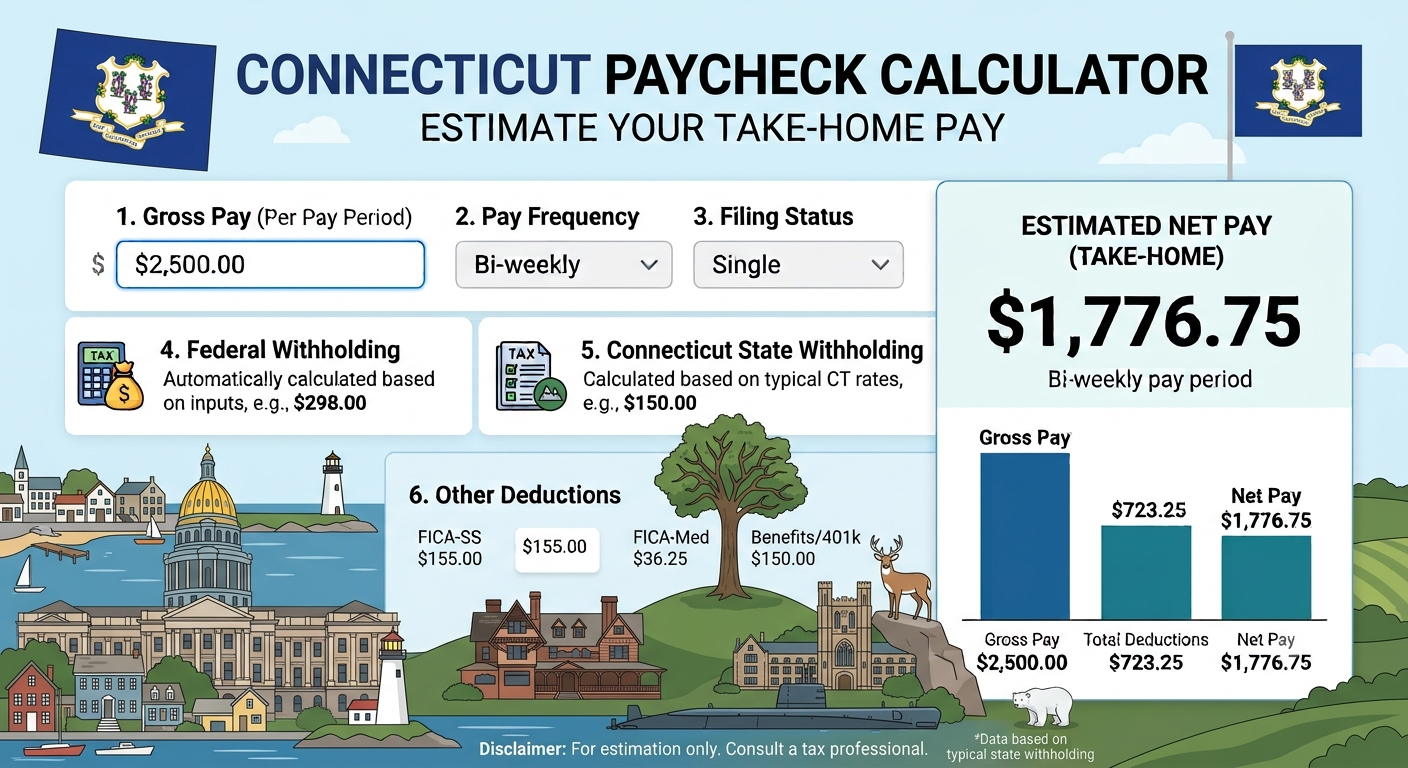
Connecticut Paycheck Calculator
Estimate your Connecticut take-home pay after federal income tax, Connecticut income tax, Social Security, Medicare and other paycheck deductions.
Connecticut Paycheck Calculator 2026
The Connecticut Paycheck Calculator helps employees estimate their take-home pay after federal income tax, Connecticut income tax, Social Security, Medicare and other paycheck deductions.
Unlike states that use a single state income-tax rate, Connecticut uses a graduated individual income-tax system. The amount of Connecticut income tax depends on taxable income and filing status.
How the Connecticut Paycheck Calculator Works
Start by entering your annual salary or hourly wage. Then select how often you are paid and choose your federal filing status.
The calculator estimates annual federal income tax, Connecticut income tax, Social Security and Medicare. It then converts those annual amounts into an estimated amount for each paycheck.
Connecticut Income Tax Rates 2026
Connecticut uses graduated individual income-tax rates. For 2026, Connecticut individual income-tax rates range from 2% to 6.99%, depending on taxable income and filing status.
Connecticut also has special rules involving tax brackets, phase-ins, exemptions and credits. Therefore, an actual Connecticut withholding amount can differ from a simple percentage calculation.
Connecticut Federal Payroll Taxes
Connecticut employees are also subject to federal payroll taxes. These generally include Social Security and Medicare taxes.
Social Security Tax in Connecticut
For 2026, the employee Social Security tax rate is 6.2%.
The 2026 Social Security wage base is $184,500. Once an employee reaches the Social Security wage base during the year, additional wages are not subject to the 6.2% employee Social Security tax.
Medicare Tax in Connecticut
The standard employee Medicare tax rate is 1.45%.
Medicare generally does not have the Social Security wage base limit. An additional 0.9% Medicare tax can apply to wages above $200,000 under federal withholding rules.
Federal Income Tax
Federal income tax withholding depends on your filing status, taxable income, deductions, credits and Form W-4 information.
The calculator estimates federal income tax using 2026 federal tax brackets and standard deductions. Actual payroll withholding can vary depending on your W-4 and employer payroll system.
Connecticut Paycheck Examples
Use a $40,000 salary to compare estimated weekly, biweekly and monthly Connecticut take-home pay.
A useful example for understanding federal and Connecticut state paycheck deductions.
A higher salary example that demonstrates how graduated Connecticut tax rates can affect the estimate.
Weekly vs. Biweekly Paychecks in Connecticut
Employees paid weekly generally receive 52 paychecks per year. Biweekly employees normally receive 26 paychecks. Employees paid semi-monthly generally receive 24 paychecks, while monthly employees generally receive 12.
Changing pay frequency does not change the annual salary. It changes how the annual compensation is divided between individual paychecks.
Hourly Pay and Overtime
Hourly employees can enter their hourly wage and regular weekly hours. The calculator also allows overtime hours and an overtime multiplier to estimate annual earnings.
Actual overtime eligibility and overtime compensation may depend on federal law, Connecticut law, employee classification and employer policies.
Pre-Tax and Post-Tax Deductions
Your paycheck can include deductions for retirement plans, health insurance and other employee benefits.
The tax treatment of deductions depends on the specific benefit or payroll deduction. This calculator allows you to enter pre-tax and post-tax deductions separately for planning purposes.
Why Your Actual Connecticut Paycheck May Differ
An online calculator is an estimate and cannot reproduce every detail of an employer’s payroll system.
Your actual paycheck may differ because of Form W-4 information, Connecticut withholding information, tax credits, deductions, retirement contributions, health insurance, bonuses, additional withholding and other compensation.
Connecticut also has state-specific tax rules, exemptions and credits that can affect the final tax liability.