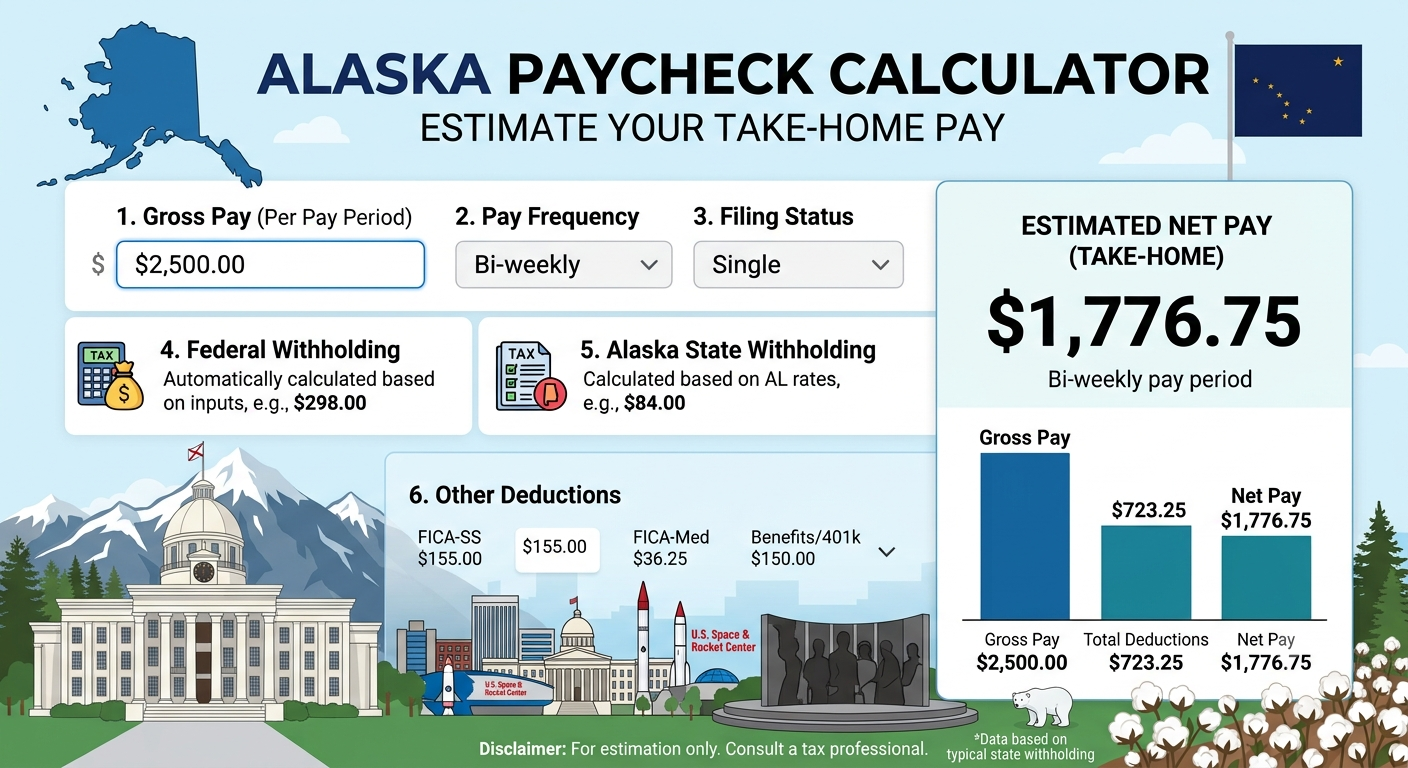
Alaska Paycheck Calculator
Estimate your Alaska take-home pay after federal income tax, Social Security, Medicare and Alaska employee payroll contributions.
Alaska Paycheck Calculator 2026
The Alaska Paycheck Calculator helps employees estimate their take-home pay after federal income tax, Social Security, Medicare, Alaska’s employee unemployment-insurance contribution and other deductions.
Unlike many states, Alaska does not impose an individual state personal income tax. This means an Alaska employee generally does not have an Alaska personal income-tax withholding deduction from a regular paycheck.
How the Alaska Paycheck Calculator Works
Enter your annual salary or hourly wage and select how often you are paid. You can also enter your filing status, pre-tax deductions, post-tax deductions and overtime.
The calculator estimates annual federal income tax and federal payroll taxes, then calculates the Alaska employee unemployment-insurance contribution where applicable. The annual result is divided by your selected pay frequency.
Does Alaska Have State Income Tax?
Alaska does not have an individual state personal income tax. This is one of the most important differences between Alaska and states such as Alabama, California and New York.
Therefore, the Alaska state income-tax line in this calculator is $0 for ordinary individual wage income.
Alaska Employee Unemployment Insurance Contribution
Although Alaska does not have an individual income tax, Alaska employees can have an unemployment-insurance contribution deducted from wages.
For 2026, the Alaska Department of Labor and Workforce Development lists a 0.50% employee rate and a $54,200 taxable wage base. The maximum standard employee contribution at that rate is therefore $271 for 2026.
The employee contribution is separate from federal income tax, Social Security and Medicare.
Federal Income Tax for Alaska Employees
Alaska residents who earn wages are generally still subject to federal income tax. Federal income-tax rules apply even though Alaska has no individual state income tax.
For 2026, the federal standard deduction is $16,100 for single filers and married individuals filing separately, $24,150 for heads of household and $32,200 for married couples filing jointly.
The 2026 federal income-tax brackets range from 10% to 37%. The tax is progressive, meaning higher rates apply only to income within the corresponding tax brackets.
Social Security Tax in Alaska
Social Security is a federal payroll tax and therefore applies to qualifying Alaska wages just as it does in other states.
For 2026, the employee Social Security rate is 6.2%. The Social Security wage base is $184,500.
Medicare Tax in Alaska
The employee Medicare tax rate is 1.45% and Medicare has no wage base limit.
An additional 0.9% Medicare withholding generally begins when an employer pays an employee more than $200,000 in Medicare wages during the year.
Alaska Paycheck Examples
A sample annual Alaska salary for comparing estimated take-home pay.
A common salary example for comparing weekly, biweekly, semi-monthly and monthly pay.
A higher salary example where federal taxes and payroll deductions become more significant.
Weekly, Biweekly and Monthly Pay
Weekly employees generally receive 52 paychecks per year, while biweekly employees generally receive 26. Semi-monthly employees generally receive 24 paychecks and monthly employees receive 12.
Your pay frequency changes the size of each paycheck but normally does not change your annual salary.
Hourly Pay and Overtime
Hourly workers can enter their hourly wage, regular weekly hours and overtime hours. The calculator estimates annual earnings by multiplying regular weekly earnings and overtime earnings by 52.
Actual overtime eligibility and compensation can depend on federal law, employment classification and the employer’s payroll policies.
Pre-Tax and Post-Tax Deductions
Employees may have deductions for employer-sponsored retirement plans, health insurance, flexible spending accounts and other benefits.
The tax treatment of each deduction depends on the specific plan. Enter deductions separately to create a more useful take-home-pay estimate.
Why Your Actual Alaska Paycheck May Be Different
An online paycheck calculator provides an estimate rather than an official payroll statement. Your employer’s payroll system uses your Form W-4, payroll period, benefits, deductions and other information.
Your actual paycheck can therefore differ from this estimate, especially if you receive bonuses, commissions, taxable benefits, retirement contributions or other special compensation.