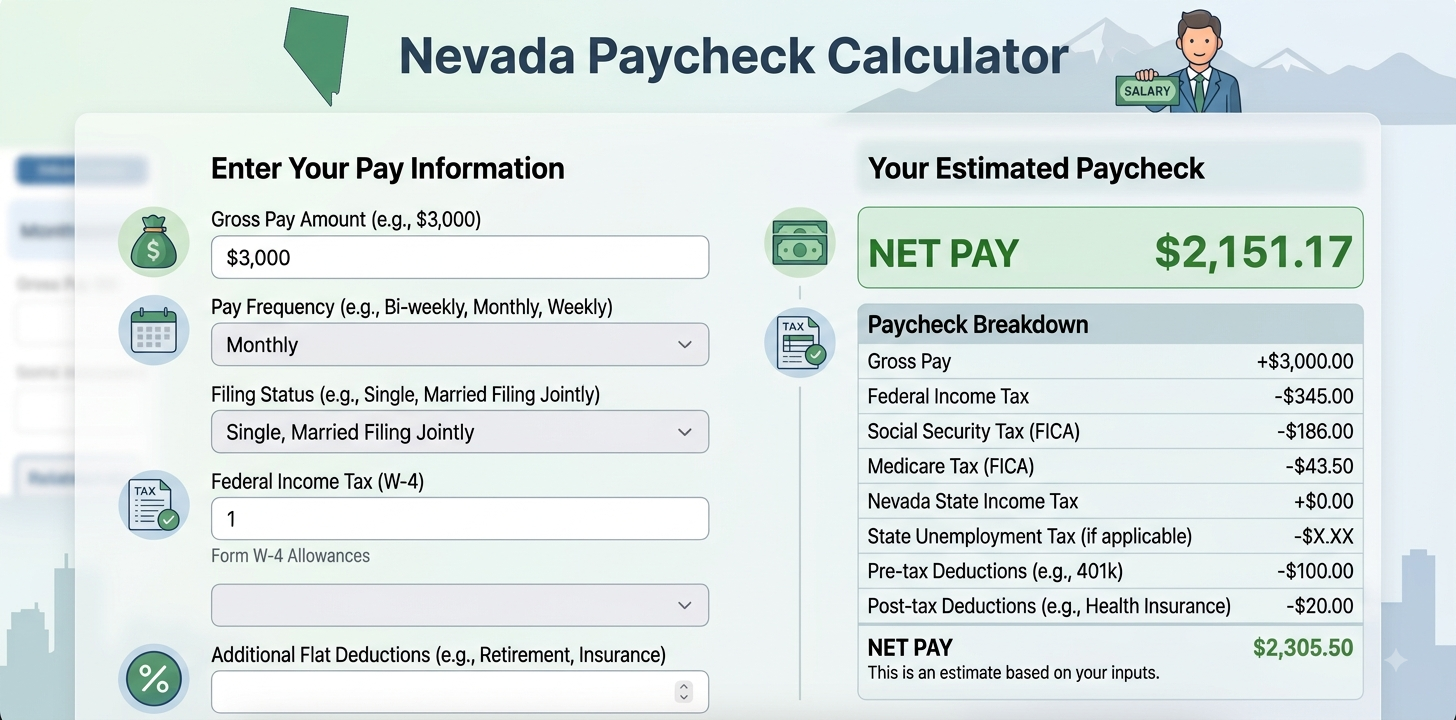
Nevada Paycheck Calculator
Estimate your 2026 Nevada take-home pay after federal income tax, Social Security, Medicare and other deductions. Nevada does not impose an individual state income tax on wages.
0%
Nevada does not impose an individual state income tax on wages.
Nevada Paycheck Calculator 2026
The Nevada Paycheck Calculator helps employees estimate their take-home pay after federal income tax, Social Security, Medicare and other deductions.
This means an employee working in Nevada generally does not have Nevada individual income tax withheld from ordinary wages.
Does Nevada Have State Income Tax?
No. Nevada does not impose an individual state income tax on employee wages. Therefore, this calculator uses a $0 Nevada state income-tax deduction.
This is one of the major differences between Nevada and many other states in your 50-state paycheck calculator.
Nevada Paycheck Taxes in 2026
| Tax / Deduction | Employee Treatment |
|---|---|
| Nevada Individual Income Tax | 0% |
| Federal Income Tax | Applies |
| Social Security | 6.2% employee rate, subject to wage base |
| Medicare | 1.45% employee rate, plus Additional Medicare Tax where applicable |
Nevada Modified Business Tax Is Not an Employee Income Tax
Nevada has a Modified Business Tax, commonly called MBT. However, the MBT is a payroll tax imposed on businesses, not an individual Nevada income tax deducted from an employee’s paycheck.
Nevada’s Department of Taxation states that the general business MBT rate is currently 1.17% and that the first $50,000 of wages remains non-taxable under the applicable law. The tax is the employer’s responsibility rather than a normal employee state income-tax withholding.
For this reason, the Nevada MBT is not subtracted from the employee’s take-home pay in this calculator.
Nevada 2026 Modified Business Tax
| Business Type | Current MBT Rate | Employee Deduction? |
|---|---|---|
| General Business | 1.17% | No |
| Financial Institutions | 1.554% | No |
The Nevada Department of Taxation confirms that the MBT is imposed on employers and is calculated using employer wages, with certain health-benefit deductions and other rules. The general-business rate is 1.17%.
Social Security Tax in 2026
Social Security is a federal payroll tax. For 2026, the Social Security taxable wage base is $184,500. The employee Social Security tax rate is 6.2%.
An employee earning $184,500 or more in covered wages would reach the 2026 Social Security maximum employee contribution of $11,439.
Medicare Tax in 2026
Medicare tax is generally 1.45% for employees and applies to covered wages without the Social Security wage-base limit.
An additional 0.9% Additional Medicare Tax can apply to wages above the applicable federal threshold. This calculator includes the additional Medicare tax for wages above $200,000 as a simplified estimate for single and most filing situations.
Nevada Weekly, Biweekly and Monthly Paychecks
- Weekly: 52 paychecks per year
- Biweekly: 26 paychecks per year
- Semi-monthly: 24 paychecks per year
- Monthly: 12 paychecks per year
Nevada Paycheck Examples
Enter a $40,000 salary to estimate your Nevada take-home pay. No Nevada individual income tax is deducted.
A $60,000 salary is subject to federal payroll taxes, but no Nevada individual income tax.
At $100,000, federal income tax and payroll taxes continue to apply, while Nevada state income tax remains $0.
Why Your Actual Nevada Paycheck May Be Different
- Federal Form W-4 information
- Federal filing status
- Pre-tax retirement contributions
- Health insurance deductions
- HSA or other qualifying deductions
- Post-tax deductions
- Additional federal withholding
- Additional Medicare Tax where applicable
- Employer-specific payroll policies
Nevada Paycheck Calculator FAQ
Nevada Department of Taxation — Modified Business Tax.
The Nevada Department of Taxation states that the general business MBT rate is 1.17% and that the first $50,000 of wages remains non-taxable under the applicable MBT rules.
Social Security Administration — 2026 Contribution and Benefit Base: $184,500. Employee OASDI rate: 6.2%.